Bitcoin Treasury Strategy
How Much Bitcoin Can Your Business Safely Hold?
By Glenn Cameron, CFA
Every company considering a Bitcoin allocation faces the same question. And almost all of them get it wrong. Not because Bitcoin is risky, but because they don't have a framework for answering it.
I've spent years building institutional Bitcoin custody infrastructure and advising companies on treasury allocation. I've seen companies allocate well, and I've seen companies get into trouble. The difference is never conviction about Bitcoin. It's whether they did the maths on their own business first.
Here's the framework I use. It takes about five minutes with your own financials, and it gives you a number you can actually defend to your board, your accountant, or yourself.
The three mistakes companies make
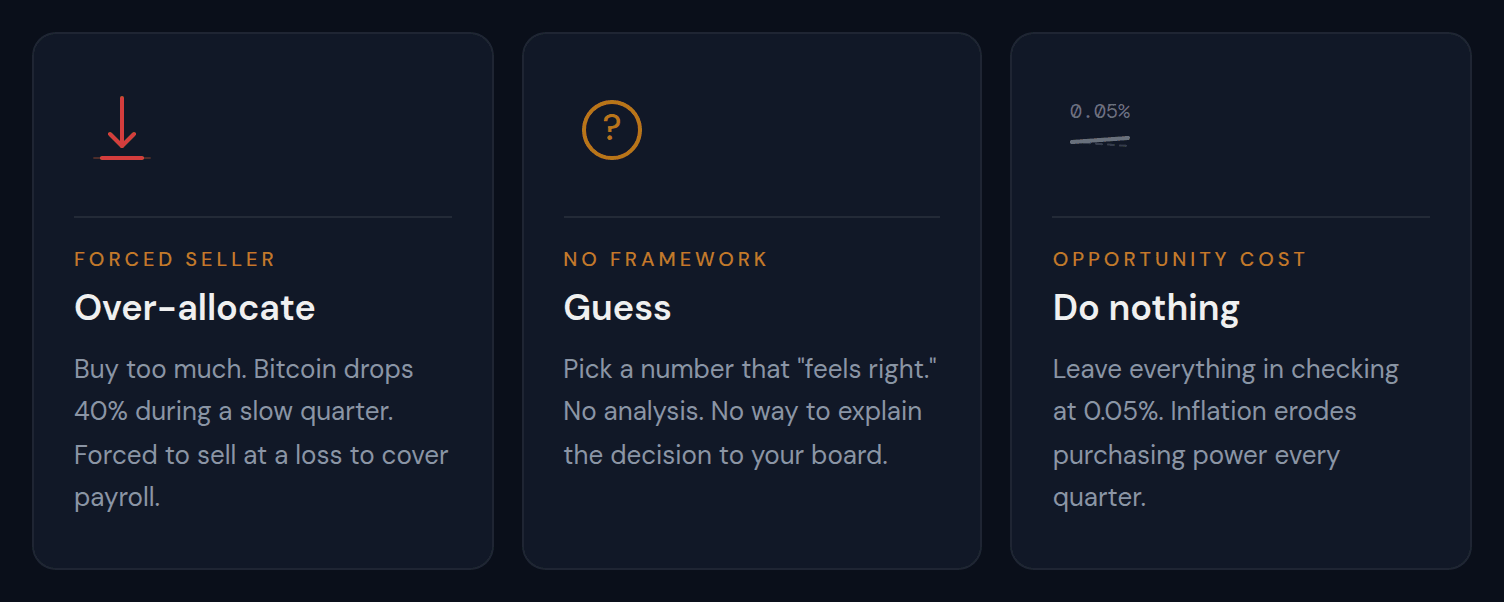
Before the framework, let's name the three ways this goes wrong.
Over-allocate.You buy too much Bitcoin relative to your cash needs. A market downturn hits at the same time as a slow quarter. You're forced to sell at a loss to cover payroll. This is the nightmare scenario that makes CFOs hesitant about Bitcoin entirely, and it's completely avoidable with basic cash flow analysis.
Guess.You pick a number that “feels right.” Maybe 5% of cash, maybe whatever's left at the end of the quarter. No analysis behind it. No framework. No way to explain the decision to anyone who asks. This is how most companies currently operate, and it means they're either taking too much risk or leaving opportunity on the table.
Do nothing.You leave everything in a checking account earning 0.05% while inflation erodes your purchasing power at 3-4% per year. The opportunity cost compounds every quarter you wait. Most business owners know this. They just don't have the numbers to make a confident move.
The framework eliminates all three mistakes. It replaces instinct with arithmetic.
Step 1: Know your real free cash flow
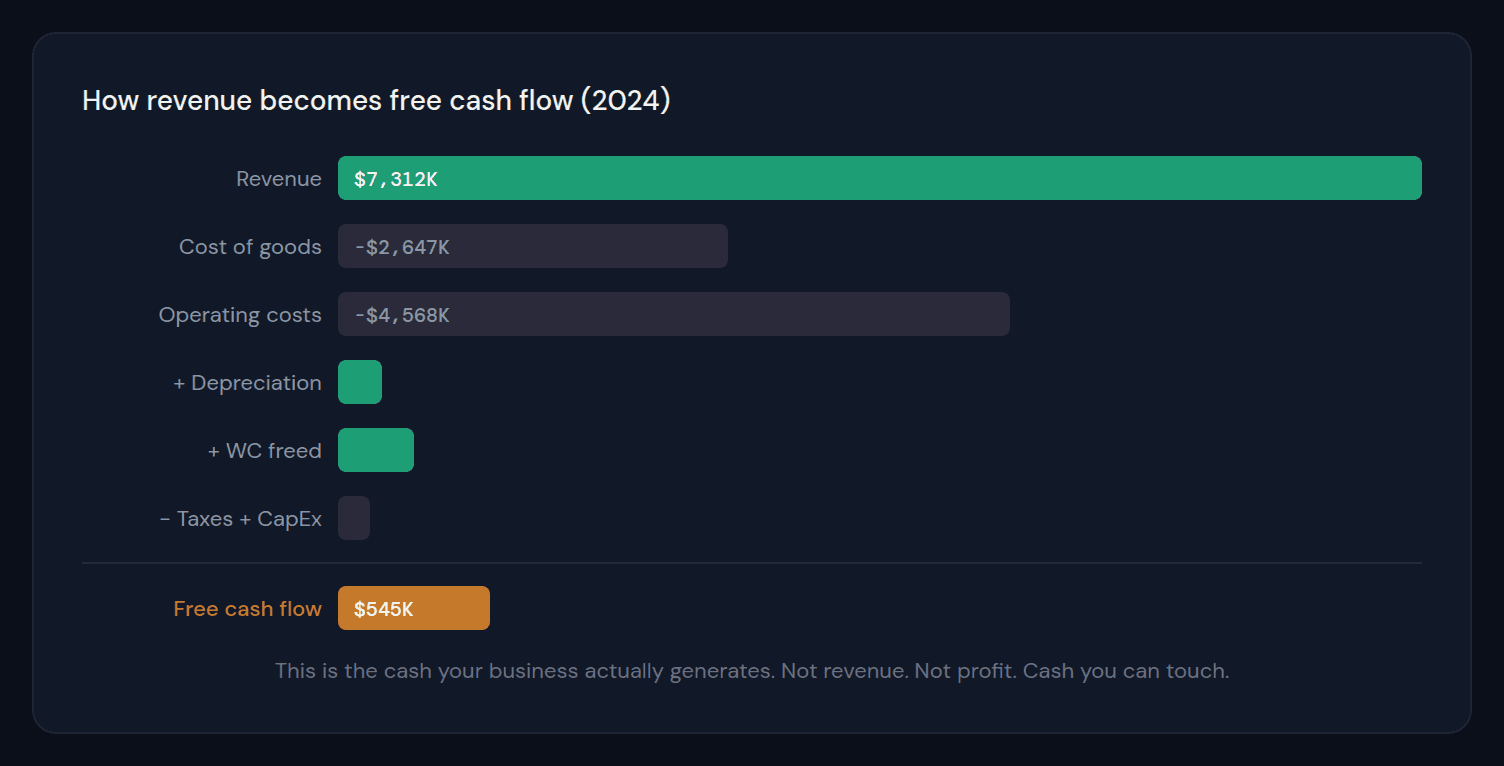
Revenue is not cash flow. Profit is not cash flow. The number that matters is unlevered free cash flow: how much actual cash your business generates after paying for everything it needs to operate.
In plain English: take your operating income, add back non-cash expenses like depreciation (you didn't actually spend that money), subtract taxes, and adjust for changes in working capital (money tied up in invoices and inventory) and capital expenditure (equipment, vehicles, buildouts).
What you're left with is the cash that genuinely belongs to the business. Not accounting profit. Not revenue. Cash you can touch.
For a real example, I analysed a US healthcare services company with $7.3 million in annual revenue. Their accounting profit looked healthy, but their actual free cash flow averaged $419,000 per yearover a five-year period. That's the real number, and it's very different from what you'd see on their income statement.
Step 2: Size your safety buffer
Before you allocate a single pound or dollar to Bitcoin, you need to know how much cash your business needs as a safety net.
Think of it like personal finance. Financial advisors tell individuals to keep three to six months of expenses in an accessible savings account before investing. The same principle applies to businesses, but sized to your actual operating costs.
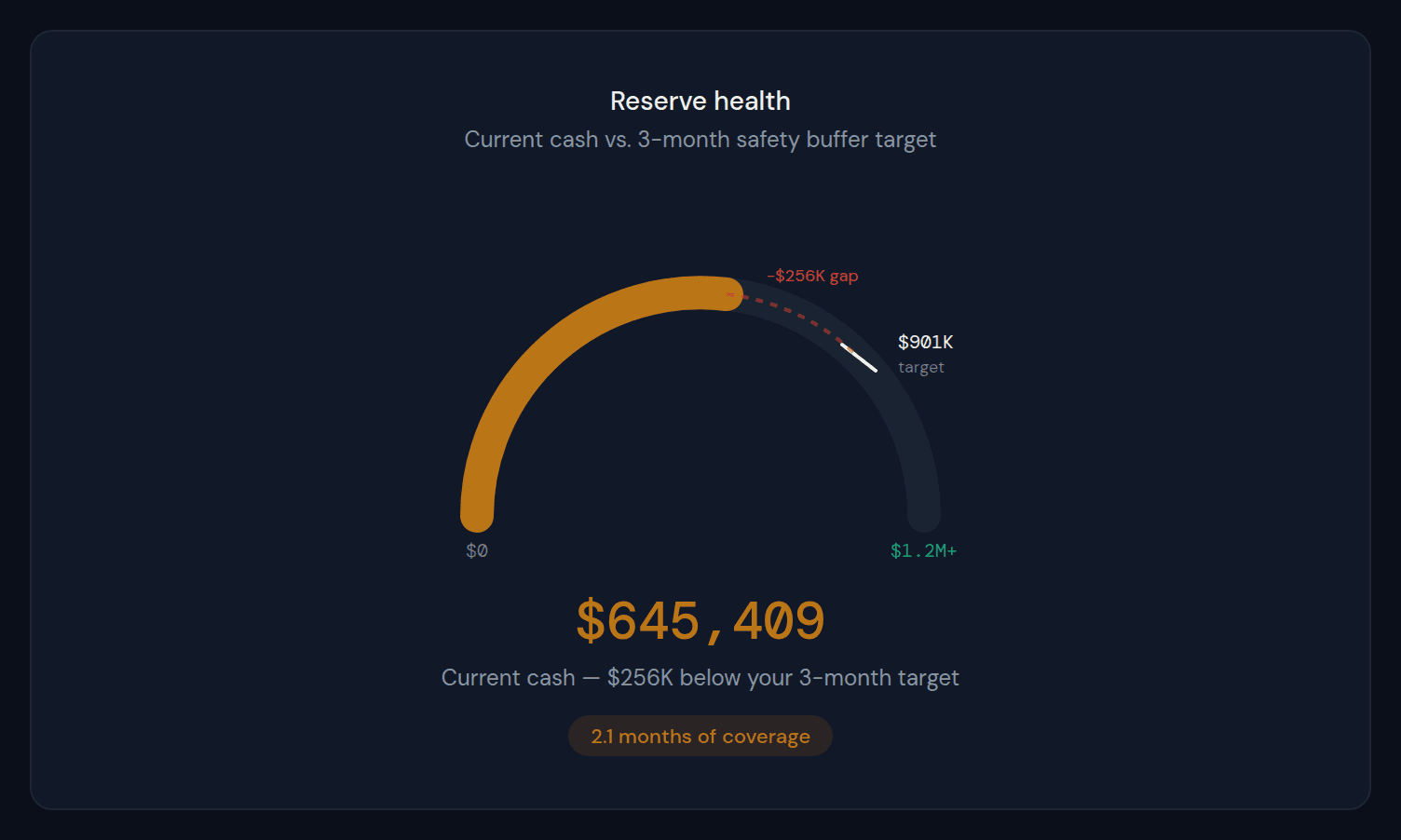
Take your average monthly cash operating expenses (rent, salaries, insurance, suppliers, everything you actually pay) and multiply by three. That's your minimum safety buffer. It's the amount of cash that needs to stay liquid and accessible at all times.
For the healthcare company: their average monthly operating costs were $300,548. Three months of that is $901,644. That's the line. Cash above that line is surplus. Cash below it is operating reserve.
The specific number matters enormously. A company that “feels like” it needs a million dollars in reserve might actually need $600,000, or it might need $1.2 million. Without doing the calculation on your actual expenses, you're either sitting on too much idle cash or running too thin.
Step 3: Calculate your Bitcoin budget
Once you know your free cash flow and your safety buffer, the Bitcoin budget calculates itself.
Your free cash flow is the pool of cash available for allocation. Your safety buffer is the amount you need to keep in reserve. Everything above the buffer, funded by ongoing free cash flow, is your Bitcoin budget.
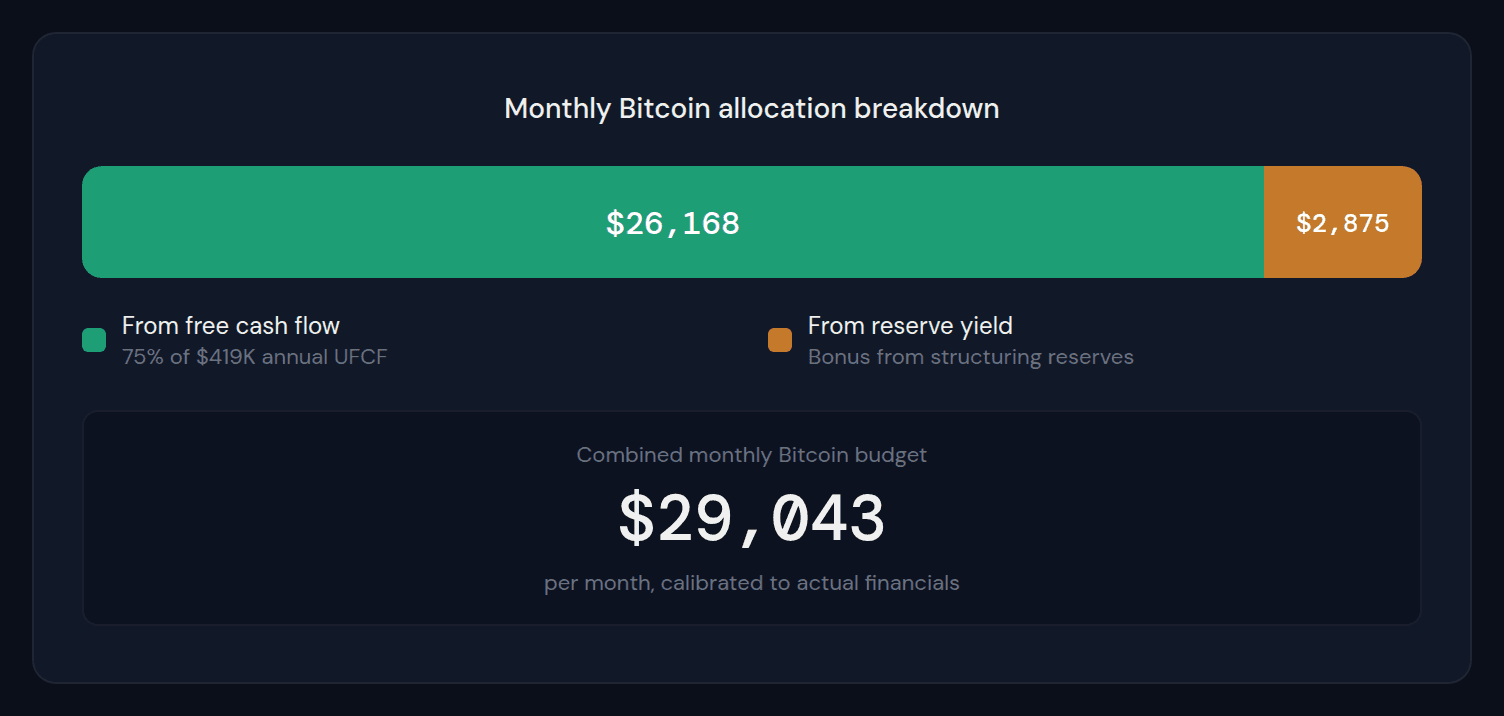
The healthcare company generates $419,000 per year in free cash flow. At a 75% allocation rate (keeping 25% as an additional cushion), that's $26,168 per month available for dollar-cost averaging into Bitcoin.
That's not a guess. That's not a feeling. It's a number derived directly from their income statement and balance sheet, and it's a number they can defend to any stakeholder who asks “how did you decide on this amount?”
The discovery most companies make along the way
Here's something I didn't expect when I first built this analysis. The reserve calculation reveals a second opportunity that most businesses are completely ignoring.
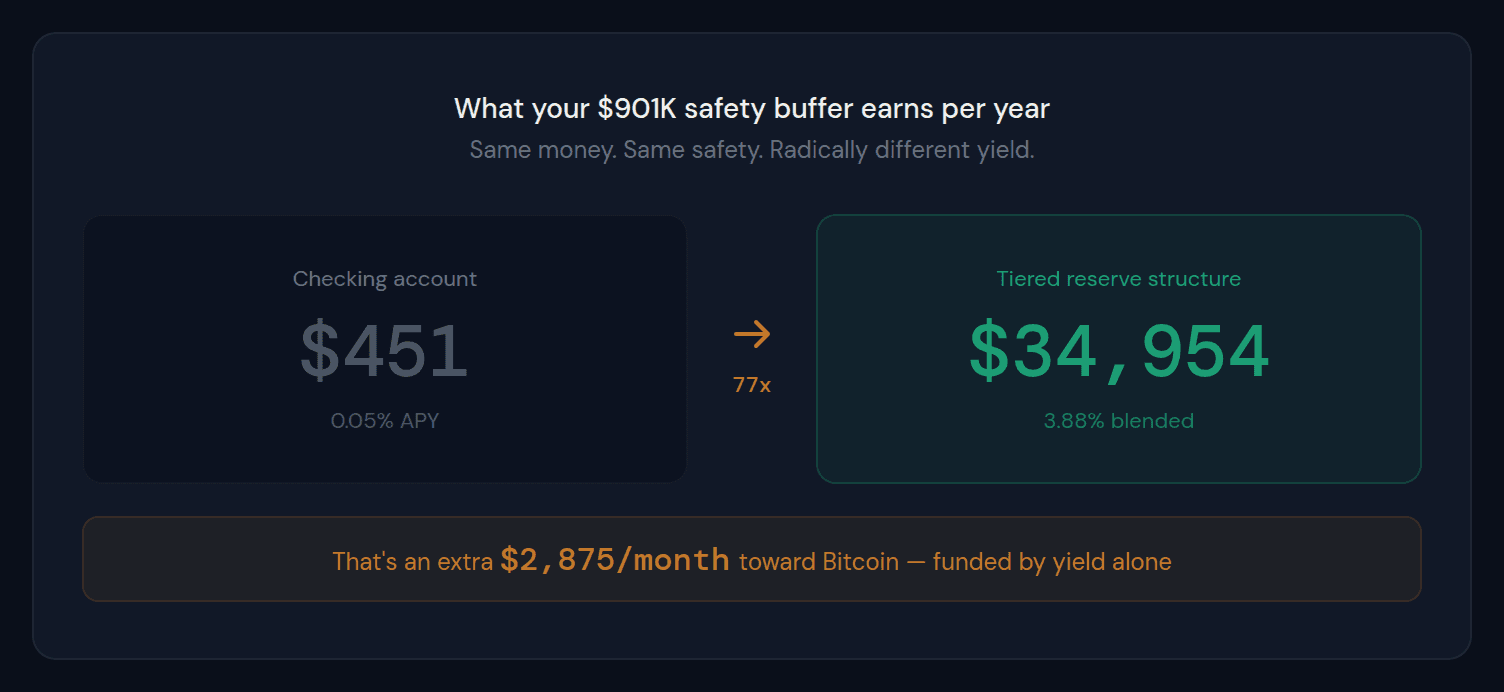
That safety buffer ($901,644 for our example company) is almost certainly sitting in a checking account earning 0.05% interest. That's $451 per year.
But the safety buffer doesn't need to be in a checking account. It needs to be liquid and accessible, but it can be structured across high-yield savings accounts, Treasury bills, and money market funds. All of these are just as safe as a checking account but yield dramatically more.
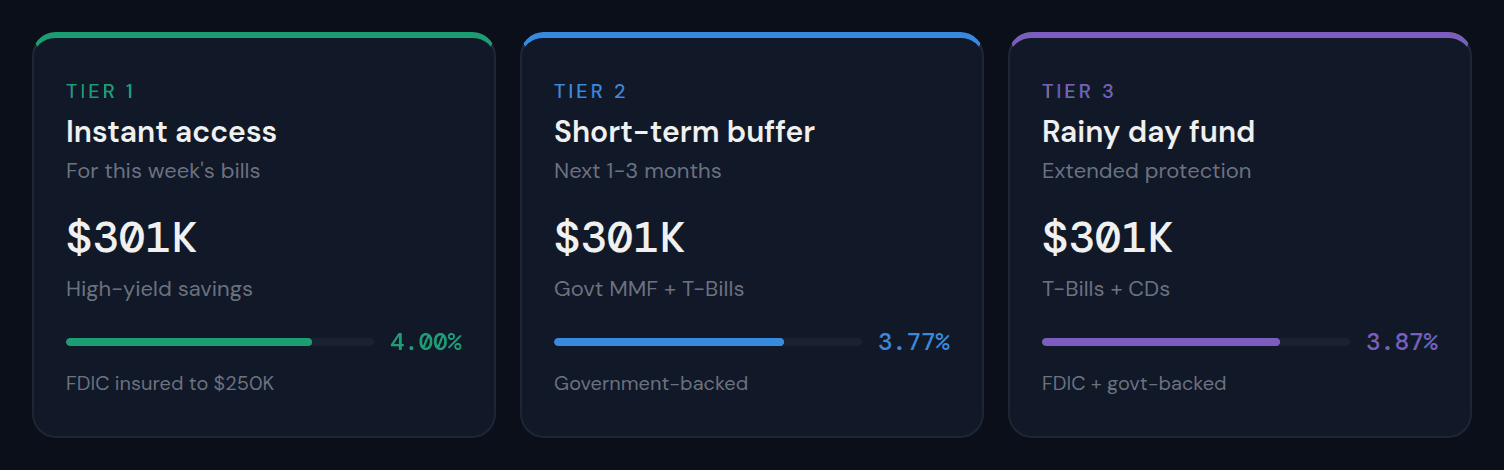
With a simple three-tier reserve structure, the same $901,644 earns $34,954 per year. That's an extra $2,875 per month, funded entirely by yield on money you were already holding. And that yield bonus can go straight into your Bitcoin accumulation on top of the DCA budget you already calculated.
The total monthly Bitcoin allocation becomes $26,168 from free cash flow plus $2,875 from reserve yield. Nearly $29,000 per month, all from money the business was already generating or holding.
Want your number?
I'm building TreasuryPilot to automate exactly this analysis. Upload your financials (QuickBooks, Xero, or any spreadsheet) and get your free cash flow, your reserve target, your yield comparison, and your Bitcoin DCA budget calculated from your actual numbers. Everything runs in your browser. Your financial data never touches a server.
It's free. It launches soon.
Frequently asked questions
How much Bitcoin should a small business hold?
There is no universal answer. The right amount depends on your free cash flow, your operating expenses, and how large a safety buffer your business needs. TreasuryPilot calculates this from your actual financial statements: free cash flow minus a 3-month reserve target equals your maximum Bitcoin allocation.
What is unlevered free cash flow and why does it matter for Bitcoin allocation?
Unlevered free cash flow (UFCF) is the cash your business generates after paying all operating costs, taxes, and capital expenditure, but before debt payments. It matters because it represents the true surplus cash available for strategic allocation, including Bitcoin. Revenue and accounting profit can be misleading.
How much cash reserves should a business keep before buying Bitcoin?
A common guideline is 3 months of cash operating expenses. This covers payroll, rent, insurance, and supplier payments during a revenue disruption. The exact amount depends on your actual monthly costs, which vary significantly between businesses. Calculate yours from your income statement before allocating to Bitcoin.
Can a small business dollar-cost average into Bitcoin?
Yes. Dollar-cost averaging (buying a fixed amount on a regular schedule) is the approach most suited to small businesses. It avoids the risk of buying a large amount at a single price point. TreasuryPilot calculates your monthly DCA budget from your free cash flow so you never allocate more than your business can afford.
Is TreasuryPilot free to use?
Yes. The upload-based analysis is completely free and runs entirely in your browser. Your financial data never leaves your device. A Pro tier with bank connectivity, cash flow forecasting, and Bitcoin wallet tracking is coming soon.
Join the waitlist
Get early access and a free treasury analysis for your business.
Glenn Cameron is a CFA charterholder with years of experience in institutional Bitcoin strategy and custody. TreasuryPilot is an analytical tool, not investment advice. It does not recommend specific financial products or investment strategies.